
説明
ADA-Compliant Access Booth
Part 1: The Mandate for Dignity
In the modern built environment, accessibility is not a “feature”—it is a civil right. For decades, the acoustic booth market ignored a significant demographic. Standard phone booths, with their 100mm step-up thresholds and narrow 700mm doors, are physical barriers to the 65 million people worldwide who use wheelchairs. They are discriminatory by design.
The Demountable ADA Phone Booth is the correction to this oversight. It is engineered to meet and exceed the strict requirements of the Americans with Disabilities Act (ADA), the UK Equality Act, and European EN 17210 standards.
This product is not just about avoiding lawsuits; it is about Dignity. It ensures that an employee in a wheelchair has the exact same access to privacy and focus as their able-bodied colleagues. It is a “Universal Design” asset—spacious, zero-threshold, and barrier-free—that serves everyone better, while keeping the facility manager legally compliant.
Part 2: The Geometry of Inclusion (Regulatory Engineering)
Designing a booth that is both Demountable (collapsible) and ADA Compliant (accessible) presents a massive engineering contradiction. ADA requires large clear floor spaces and zero thresholds, while demountable structures usually rely on thick floor chassis for stability. We have solved this through advanced structural engineering.
1. The Zero-Threshold Challenge
The defining failure of most booths is the “Step Up.”
-
The Innovation: Our ADA booth utilizes a patent-pending Ultra-Low Profile Chassis (less than 12mm rise) combined with an integrated 1:12 slope entry ramp.
-
The Result: A user can roll directly into the booth without effort. There is no tripping hazard. The transition from the office carpet to the booth floor is seamless, meeting the strict “Change in Level” requirements of ADA Section 303.
2. The 60-Inch Turning Circle
Compliance is a matter of geometry.
-
The Footprint: To allow a wheelchair to enter, turn 180 degrees, and exit, the interior requires a 60-inch (1525mm) diameter clear turning space.
-
The Dimensions: Consequently, this booth is significantly larger than a standard unit. The typical footprint is 2200mm (W) x 2200mm (D). This massive internal volume also makes it a luxurious “Executive Office” for non-wheelchair users, reinforcing the principle that “Universal Design benefits everyone.”
3. The “Force-5” Door System
A heavy acoustic door is usually hard to open. ADA Section 404.2.9 requires that interior doors require no more than 5 lbs (22.2 N) of force to open.
-
The Hardware: We utilize a specialized Hydraulic Assist Hinge or an optional Auto-Operator (push-button entry).
-
The Width: The door provides a minimum clear width of 36 inches (915mm), exceeding the 32-inch requirement, ensuring that even large motorized scooters can enter without scraping their knuckles on the frame.
-
The Handle: Lever-style or loop handles that can be operated with a closed fist (no tight grasping or twisting required), positioned at the compliant height of 34-48 inches.
4. Accessible Controls & Acoustics
-
Reach Ranges: All power sockets, light switches, and fan controls are positioned between 15 inches and 48 inches from the floor (ADA Section 308). A user never has to stand up or reach high to control their environment.
-
Visual Alarms: For users with hearing impairments, the booth can be integrated with the building’s fire alarm system, featuring a Visual Strobe Light inside the pod to alert the user of an emergency.
-
Acoustics: Despite the large door and zero threshold, we maintain an STC rating of 30-33dB using drop-down seals that automatically deploy when the door closes.
Part 3: The “Compliance” Customer Base
Who buys ADA booths? Organizations that view Risk, Regulation, and Reputation as primary drivers.
1. Government & Municipal Facilities
-
The Context: Courthouses, City Halls, DMV offices, Federal Buildings.
-
The Obligation: Title II of the ADA mandates that public entities must be accessible. A non-compliant phone booth in a federal building is a lawsuit waiting to happen.
-
The Use Case: Private booths for citizens to fill out forms or for public defenders to speak with clients.
2. Higher Education (Title IX / ADA)
-
The Context: Universities and Colleges.
-
The Obligation: They serve a diverse student population. If a library installs 10 phone booths and none are accessible, they are violating discrimination laws.
-
The Use Case: “Proctored Exam Pods.” Students with disabilities need quiet, distraction-free spaces for test-taking. This booth provides the perfect controlled environment.
3. Fortune 500 Corporate (DE&I Initiatives)
-
The Context: Major corporations with Diversity, Equity, and Inclusion (DE&I) departments.
-
The Obligation: It is not just about law; it is about brand. A company claiming to be inclusive cannot install exclusionary furniture.
-
The Use Case: The ADA booth is often the flagship unit in the lobby, signaling to all visitors that “We welcome everyone here.”
4. Healthcare Systems
-
The Context: Hospitals and Rehabilitation Centers.
-
The Obligation: High density of mobility-impaired users (patients in wheelchairs, walkers).
-
The Use Case: Tele-health consultation rooms for patients. A patient in a wheelchair can roll in for a private video conference with a specialist in another city.
Part 4: Logistics of the “Wide Load” (FOB Export)
Exporting an ADA booth is logistically distinct from standard booths due to its sheer size. It is a “Wide Load” in the furniture world.
1. FOB (Free On Board) – The Project Volume
We trade on FOB Terms (FOB Shanghai / Ningbo).
-
The Scale: Because ADA booths are larger, they take up more container space.
-
The Mix: Most clients do not buy a full container of ADA booths. They buy a “Compliance Mix”: for every 10 standard booths, they buy 1 ADA booth. Buying FOB allows you to mix these SKUs in a single container, optimizing your freight spend.
2. The Panel Size Challenge
A standard booth wall is 1 meter wide. An ADA booth wall is over 2 meters wide.
-
Handling: These panels are too heavy for a single person to lift.
-
Packaging: We use Horizontal Crating. The panels are packed flat on large 2.2m x 1.2m pallets.
-
Warehouse Equipment: Your warehouse must have a forklift with long forks or fork-extensions to handle these pallets safely without tipping.
3. Container Loading (The 40HQ Strategy)
-
20ft Container: Not recommended. You might only fit 4-5 units due to the pallet size.
-
40ft HQ Container: This is the only efficient way. We can fit 12–15 Units of ADA booths.
-
Landed Cost: Due to the lower quantity per container, the shipping cost per unit is higher than a standard booth. Distributors must factor this “Accessibility Premium” into their pricing model.
4. Documentation & Certification
-
The “Blue Badge” Docs: We provide specific technical drawings verifying the turning circles and threshold heights. These documents are often required by local Building Inspectors or Fire Marshals before they will sign off on the occupancy permit.
-
Fire Rating: Because the egress path is critical for disabled users, we strictly adhere to ASTM E84 Class A for all interior finishes. We provide the burn test certificates with the Bill of Lading.
Part 5: The “Universal” Assembly Process
Installing an ADA booth requires precision. The floor must be perfectly flat to ensure the threshold works correctly.
1. The Laser-Leveled Base
-
The Critical Step: Standard booths can tolerate a slightly uneven floor. An ADA booth cannot. If the floor twists, the automatic door operator will jam.
-
The Solution: Our chassis features 20+ Micro-Adjustable Leveling Feet. The installer uses a laser level to create a perfectly flat platform before building the walls.
2. The “Panel-to-Post” Connection
-
Demountability: Despite its size, the booth uses the same Cam-Lock or Hook-Fastener system as our smaller units.
-
Crew Size: Due to the weight of the large panels, a 3-Person Crew is required (two to hold, one to lock).
-
Time: Assembly takes approximately 3 to 4 hours per unit.
3. The Electrical “Umbilical”
-
Accessibility: The main power connection is located at the base, not the ceiling, making it easier for maintenance staff to access without ladders (safety first).
-
Automation: If the unit has an automatic door opener, it plugs directly into the booth’s integrated control box. No external electrician is needed to wire the motor.
Part 6: The Industrial Synergy (Accessible Metal Furniture)
(Transition)
A facility manager purchasing an ADA Phone Booth is focused on Compliance and Durability. They are likely outfitting a government building, a university, or a corporate HQ with a strict mandate for universal access.
They cannot furnish the rest of the space with fragile, non-compliant furniture. They need Metal Furniture that meets the same rigorous standards: distinct color contrast for the visually impaired, specific handle heights, and rugged durability to withstand impact from wheelchair footrests.
Sourcing Custom Metal Furniture from the same factory ensures that the “Safety Yellow” or “Contrast Blue” powder coat on the furniture matches the safety markings on the booth, creating a unified, compliant environment.
Part 7: Bespoke Metal Customization – The “Universal Design” Series
(1000 Words on Accessible/Institutional Metal Fabrication)
Tone: Ergonomic, Safe, Institutional. This section focuses on furniture designed for Access. It emphasizes knee clearances, reach ranges, handle leverage, and stability. It is the furniture of “Care and Compliance.”
Here are six specific categories of metal furniture that fit the “Universal Design” philosophy.
1. The ADA-Height Adjustable Metal Desk
Standard fixed-height desks often do not provide enough knee clearance for wheelchair arms.
-
The Design: A heavy-duty steel electric sit-stand frame.
-
Customization Specs:
-
The Frame: We use a “C-Leg” design (legs pushed to the back) rather than a “T-Leg” (legs in the middle). This creates maximum unobstructed knee space for the wheelchair user to roll fully under the desk.
-
The Controller: The control panel is mounted on an angled bracket at the front edge, ensuring it is visible and reachable for a user with limited dexterity.
-
Anti-Collision: High-sensitivity gyro sensors. If the desk hits the arm of a wheelchair while lowering, it instantly stops and reverses to prevent injury.
-
Stability: Weighted steel feet (700mm long) prevent the desk from tipping even if a user leans heavily on the front edge for support while transferring.
-
2. The “Easy-Glide” Lateral Filing Cabinet
Traditional vertical files are deep and hard to reach from a seated position.
-
The Design: A low-profile, wide lateral file cabinet.
-
Customization Specs:
-
Height: We limit the height to 2-drawers or 3-drawers (max 48 inches high), ensuring the top drawer is within the ADA reach range.
-
The Handle: We use a full-width “J-Pull” integrated handle. This allows a user to hook their hand or wrist anywhere along the drawer front to pull it open, requiring no pinching or grasping.
-
Anti-Tilt: A rigorous interlock system. This is critical for safety; a user in a wheelchair cannot easily move out of the way if a heavy cabinet tips over.
-
Kick Plate: We reinforce the bottom 10 inches of the cabinet with double-thick steel (Kick Plate) to protect the finish from impacts with wheelchair footrests.
-
3. The “Wayfinder” Accessible Signage System
Compliance isn’t just about furniture; it’s about navigation.
-
The Design: Metal signage plates and pylons.
-
Customization Specs:
-
Tactile Elements: We use CNC Milling and 3D Pressing to create raised lettering and Braille directly on the metal surface. Unlike glued-on plastic beads, these metal Braille dots can never be picked off.
-
Contrast: We use matte powder coating (e.g., Matte Black background with White text) to achieve the 70% Light Reflectance Value (LRV) contrast required by ADA guidelines for the visually impaired.
-
Mounting Height: Pre-drilled mounting holes specifically positioned to ensure the sign is installed at the compliant height (60 inches to center).
-
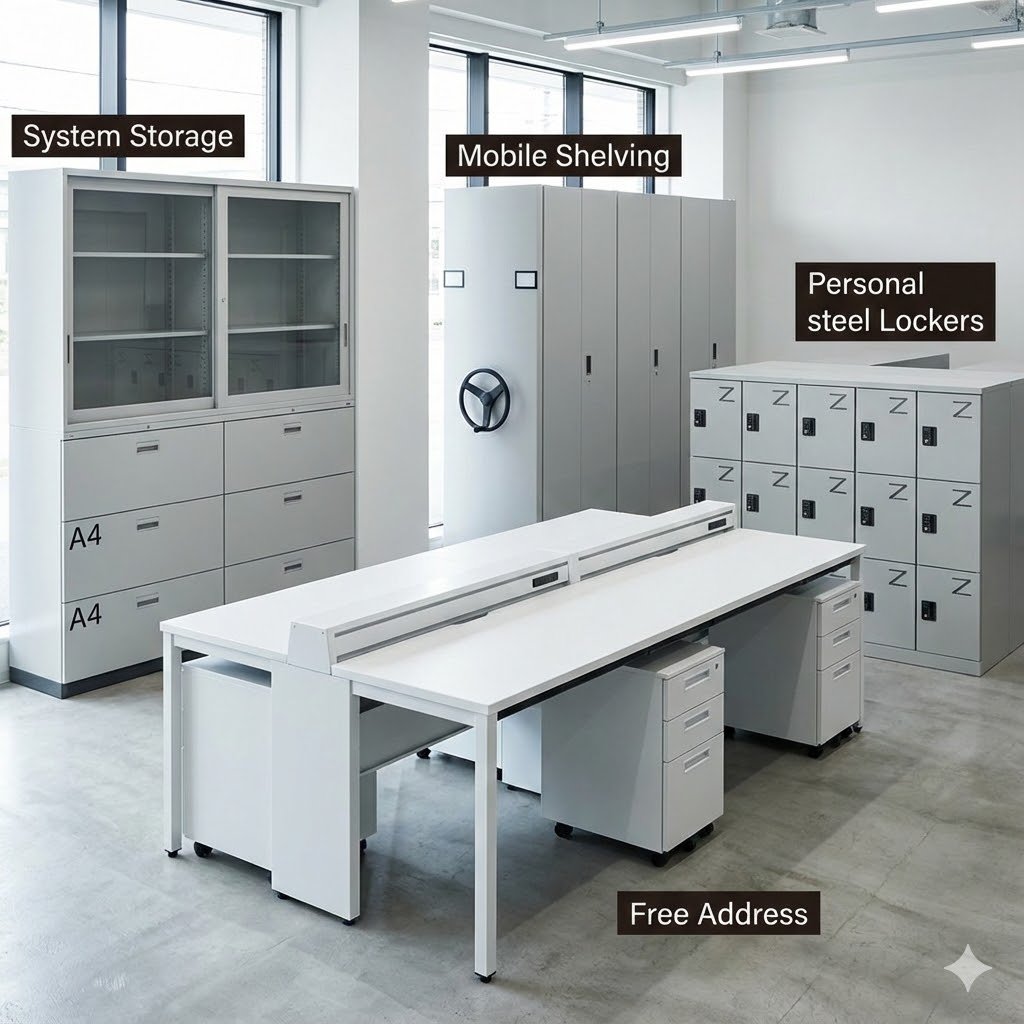
4. The “Barrier-Free” Mail & Locker System
Standard locker banks usually have top lockers that are too high and bottom lockers that are too low.
-
The Design: A “Zoned” locker system designed for universal reach.
-
Customization Specs:
-
The “Goldilocks” Zone: We manufacture locker units where the functional compartments are concentrated between 15 inches and 48 inches from the floor. The space above and below is used for long-term storage or maintenance, not daily user access.
-
Spring-Hinges: Doors are fitted with self-closing (but soft-close) hinges. If a user in a wheelchair opens a door, it won’t swing out and block their path of travel; it gently returns to the closed position.
-
Numbering: Large, high-contrast laser-cut numbers on the doors for low-vision visibility.
-
Shelving: Shelves inside are adjustable, allowing users to position them according to their specific reach capabilities.
-
5. The Heavy-Duty Wall Guard / Bumper Rail
In high-traffic accessible corridors, walls get damaged by mobility devices.
-
The Design: A sleek, architectural steel rail that acts as a bumper.
-
Customization Specs:
-
The Profile: A continuous stainless steel or powder-coated aluminum rail mounted 10 inches off the floor.
-
Impact Resistance: Engineered to withstand the impact of a 500lb power chair moving at walking speed.
-
Aesthetics: Unlike ugly plastic hospital bumpers, these are designed to look like architectural trim. We can match the color to the door frames or the booth exterior.
-
Hygiene: Being metal, it is non-porous and easy to sanitize, unlike rubber bumpers that absorb dirt.
-
6. The “Clinical” Stainless Steel Utility Cart
For healthcare environments where ADA booths are used for telemedicine.
-
The Design: A sterile, stable, rolling cart for medical instruments or laptops.
-
Customization Specs:
-
Stability: A 5-star castor base (like an office chair) or a wide H-frame to prevent tipping.
-
The Handle: A wide, continuous loop handle that allows the cart to be pushed or pulled from any angle, with one hand or two.
-
Edge Guards: Rolled steel edges on the shelves (no sharp corners) to prevent skin tears for elderly patients or those with thin skin.
-
Material: 304 Grade Stainless Steel with a brushed finish. It is magnetic (for holding instruments) and impervious to harsh hospital-grade disinfectants.
-
Conclusion: The Ethics of Engineering
By combining the Demountable ADA Phone Booth with Universal Design Metal Furniture, you are providing more than just a product; you are providing a Solution to Liability.
For the facility manager, this package is peace of mind. They know that every element—from the turning radius of the booth to the handle of the filing cabinet—has been engineered to meet the law. It protects the organization from risk, but more importantly, it builds an environment that respects the humanity of every single user. This is not just manufacturing; it is Civil Engineering in its truest sense.
 JA
JA  ZH
ZH  ZH_TW
ZH_TW  AR
AR  RU
RU  KO
KO  TH
TH  VI
VI
レビュー
レビューはまだありません。